What deliberate rebranding delivers when it’s executed across strategy, product, and measurement
What deliberate rebranding delivers when it is built on strategy, product, and measurement
Most rebrands start with a logo and end with disappointment. The ones that deliver start with a diagnosis of why the current brand is not fit for purpose, execute across product and marketing simultaneously, and measure from launch. The visual codes follow from the strategy. Reversing the order produces a new look without a new business.
Five conditions for a rebrand to deliver measurable impact: a strategic diagnosis that sets the brief, a defined target audience anchored in data rather than aspiration, a platform that bridges existing equity and new ambition rather than discarding it, product alignment so the brand does not promise what the experience cannot deliver, and a measurement framework in place before launch.
-
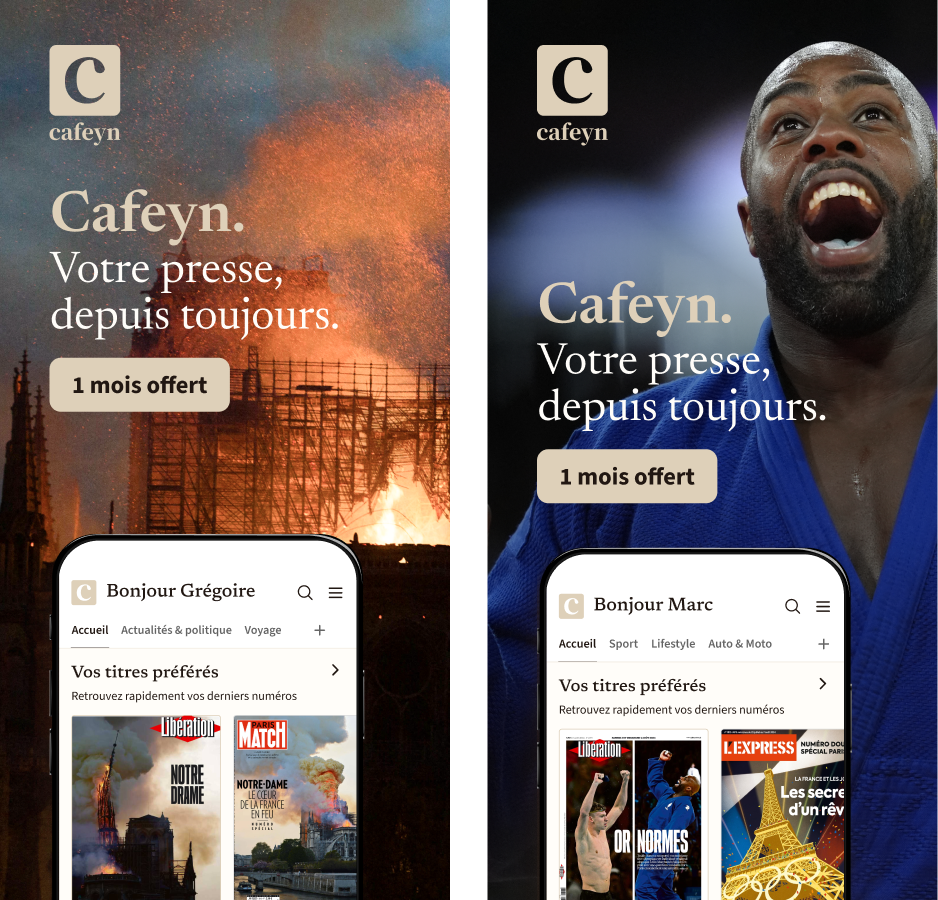
Showcase: Cafeyn
I led the full rebrand and product relaunch of Cafeyn in September 2024. Strategy, positioning, visual identity, tone of voice and creative direction. I worked hand in hand with the Product and Tech teams on the Product vision and design. The strategic objective was precise: shift the user base from a legacy 55+ audience inherited from telecom bundles toward the 35 to 54 bracket, where long-term value and brand-building potential are higher. I built the brand strategy based on a user research (JTBD method, summer 2023), defined the positioning and brand promise, designed the identity system, tone of voice, and directed the launch campaigns across brand and performance channels.
-
The results.
Within two quarters, the rebranding moved the metrics that matter for a subscription business. Acquisition volume on the target segment grew 30 per cent while cost per acquisition dropped by 23 per cent. The younger audience the brand was built to attract started walking through the door, at a lower cost than the legacy base. Brand health confirmed the shift. Cafeyn reached first place in France for conversion of brand recognition into active usage, with the strongest over-index on the professional segment the strategy was designed to reach. A brand equity tracker is now live across four markets, measuring ten dimensions across functional, emotional, and resonance tiers on an ongoing basis. The honest part. Brand shifted who arrived. Retention on the new audience lagged the legacy base. That gap was expected: the brand opened the door, the product had to earn the stay. It became the brief for the next phase of work, not a failure of the rebrand. On the strength of the results, I was promoted to Group Brand Strategist with responsibility for brand strategy across all brands in the portfolio.
-
What good brand transformation actually requires
The transformations that hold are the ones whose builders accept that brand investment compounds slowly and reveals itself in the data over quarters and years, not weeks. The discipline is to do the strategic work properly upfront, build the assets and the platform to last, and measure relentlessly so that when the results arrive they are visible and defensible. The hardest part is not the work itself. It is holding the line on the work when short-term pressure pushes for shortcuts.
-
Cafeyn influence campaign 2026
Influence campaign example #1 -
Cafeyn influence campaign 2026
Influence campaign example #2 -
Cafeyn Branded Product Demo
Cafeyn Branded Product Demo